Losing a tooth affects more than the appearance of your smile. When a tooth is missing, the underlying jawbone gradually loses density through a process called bone resorption, and the teeth on either side of the gap can begin to shift over time. Acting on tooth replacement helps protect your bite, your facial structure and your long-term oral health.
Two main clinical options exist for replacing a single missing tooth: a dental implant and a dental bridge. Each works differently, suits different clinical circumstances and involves its own set of trade-offs around cost, longevity and ongoing care. This article covers how each option works, what to expect in practical terms, and what factors a dentist will consider when helping you decide which pathway may be right for you.
What Are Your Options for Replacing a Missing Tooth?
For most adults who have lost a single tooth, a dental implant or a dental bridge are the two primary pathways for restoration. Both options restore the appearance of a complete smile and help protect the bite from the effects of a gap. Partial dentures are another possibility but are generally considered a lower-cost or interim measure rather than a long-term restoration, and they fall outside the scope of this comparison.
The right choice between an implant and a bridge depends on factors specific to each person such as bone density, the condition of the adjacent teeth, overall health, budget and treatment timeline all play a role. A clinical assessment with your dentist is the starting point for understanding which pathway may suit your individual situation.
How a Single-Tooth Dental Implant Works
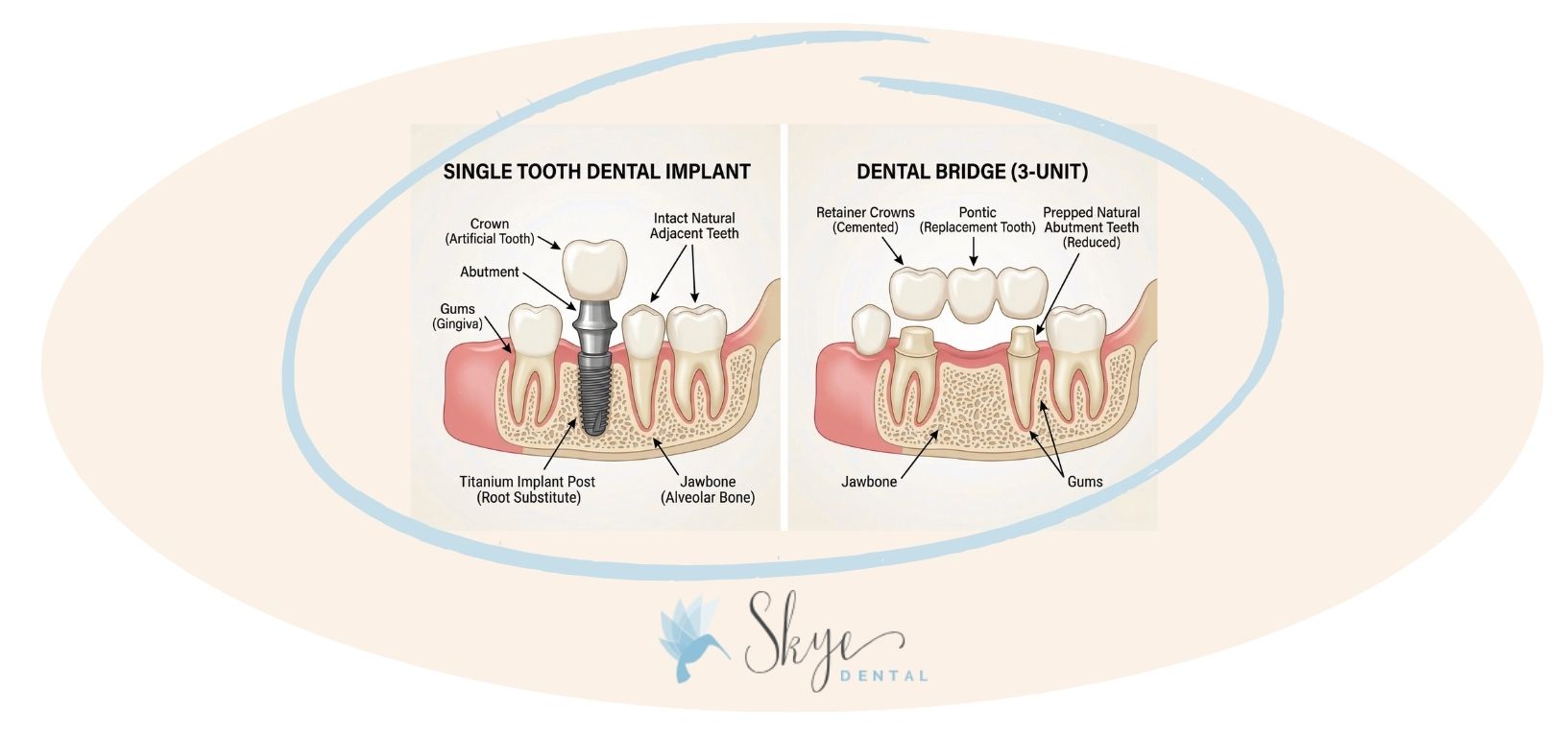
A dental implant replaces both the visible tooth and the function of the original tooth root. The restoration involves three components: the implant post, the abutment and the crown.
The implant post is a small titanium screw that a dentist or oral surgeon places directly into the jawbone during a surgical procedure. Titanium is used because it is biocompatible; the surrounding bone grows around and fuses with the post through a process called osseointegration. Osseointegration is the biological integration of the titanium post with the bone tissue, and it is what gives an implant its long-term stability and load-bearing capacity. Once osseointegration is complete, a connector piece called an abutment is attached to the post, and a custom-made dental crown is placed on top to restore the visible tooth.
The full treatment typically follows these steps:
- Initial consultation and assessment, including dental X-rays or a cone beam CT scan to evaluate bone volume and overall suitability
- Implant post placement: a surgical procedure performed under local anaesthetic
- Healing and osseointegration period, typically three to six months; longer if a bone graft is required beforehand
- Abutment placement once osseointegration is confirmed
- Crown fabrication and final placement to complete the restoration
The total treatment timeline can range from several months to over a year, depending on individual healing rates and whether preparatory procedures such as a bone graft are needed to build up bone volume before the implant post can be placed.
How a Dental Bridge Works
A dental bridge spans the gap left by a missing tooth using the teeth on either side of the space as anchors. These neighbouring teeth are known as abutment teeth. The bridge consists of two crowns placed over the prepared abutment teeth and an artificial tooth (called a pontic) suspended between them to fill the gap.
To accommodate the anchoring crowns, the dentist must remove a permanent layer of enamel from the abutment teeth. This preparation is irreversible: the abutment teeth cannot be restored to their original structure after enamel reduction, regardless of whether the bridge remains in place long term. This is a significant consideration when comparing a bridge with a dental implant, which leaves neighbouring teeth completely untouched.
The bridge is bonded permanently to the prepared abutment teeth using dental cement. Treatment typically requires two appointments. one for preparation and impressions and one to place the finished bridge, and can often be completed within a few weeks.
Implants vs Bridges: A Side-by-Side Comparison
The table below compares the two options across the factors most relevant to the decision. All cost figures are indicative estimates only and vary depending on case complexity, materials and the treating practice.
|
|
Single -Tooth Dental Implant |
Dental Bridge |
| Procedure |
Surgical placement of a titanium post (the implant) into the jawbone, topped with an abutment and a custom crown |
Non-surgical; two crowns are placed over the prepared adjacent teeth with an artificial tooth (the pontic) suspended between them |
| Key advantage |
Preserves jawbone; leaves adjacent teeth completely untouched |
No surgery required; shorter treatment timeline; accessible to patients who cannot have an implant |
| Key limitation |
Requires surgery and a healing period of several months before the final crown can be placed |
Adjacent teeth must be permanently altered by enamel removal; does not address bone loss in the jaw |
| Indicative cost (AUD)
|
Typically $4,000–$6,500 or more per tooth (estimate only; price varies by case, materials and practice) |
Typically $2,500–$5,000 (estimate only; price varies by span, materials and practice) |
| Typical longevity |
Can last many years, potentially decades in suitable cases with good oral hygiene and regular check-ups |
May require replacement after 10–15 years in many cases; long-term cost can increase with replacement cycles |
| Candidacy |
Sufficient bone density required; good general health; healthy gums; non-surgical health factors reviewed at assessment |
Healthy adjacent teeth to act as anchors; no bone volume minimum; no surgery required |
| Ongoing maintenance |
Brushed and flossed like a natural tooth; standard dental check-ups and cleans |
Requires a floss threader or interdental brush to clean beneath the pontic; standard check-ups and cleans |
Single-Tooth Dental Implants: A Closer Look
Advantages of Dental Implants
Dental implants offer several clinical advantages that distinguish them from bridge-based restorations.
- Jawbone preservation: by replicating the stimulation a natural tooth root provides, an implant can help slow the process of bone resorption that follows tooth loss
- Adjacent teeth remain untouched: the implant is entirely self-supporting and does not rely on the neighbouring teeth for anchorage, meaning those teeth are not altered in any way
- Natural function and appearance: a well-placed implant with a quality crown can closely replicate the look, feel and function of a natural tooth
- Long-term stability: with good oral hygiene and regular professional dental care, an implant can remain functional for many years and in suitable cases, potentially several decades
Limitations and Considerations
A dental implant is not suitable for every patient, and the process involves trade-offs worth understanding before committing to treatment.
- Surgical procedure: implant placement involves surgery performed under local anaesthetic, with a recovery period of several days to a couple of weeks for most patients
- Extended treatment timeline: the multi-step process, including the osseointegration period, means the total treatment can span several months to over a year
- Higher upfront cost: a single-tooth implant typically involves a greater initial investment than a bridge, though the long-term cost picture can shift depending on how frequently a bridge requires replacement over time
- Bone requirements: patients with insufficient bone density may need a bone graft procedure before an implant can be placed, which adds to the timeline and total cost
Who May Be a Suitable Candidate
A dental implant may be a suitable option for adults who have sufficient jawbone density and volume to support an implant post or who are willing to consider a bone graft if needed. Other factors that are typically assessed include good general health and no uncontrolled systemic conditions that may affect healing, healthy gums with no active gum disease, and a commitment to ongoing oral hygiene and regular dental visits.
Smoking is associated with a higher risk of implant failure and complications. Your dentist will discuss this with you during your assessment and can advise on how this may affect your candidacy and the likely outcome of treatment.
Dental Bridges: A Closer Look
Advantages of Dental Bridges
A dental bridge offers a number of practical advantages that make it a viable choice for many patients.
- No surgery required: bridge treatment does not involve a surgical procedure, making it accessible to patients for whom surgery is not a suitable pathway
- Shorter treatment timeline: a bridge can often be designed and placed within a few weeks, compared to the months required for implant treatment
- Lower upfront cost: in most cases, a dental bridge involves a lower initial cost than a single-tooth implant
- Wide suitability: a bridge may be an option for patients who do not meet the bone density requirements for an implant or who prefer to avoid a surgical procedure
Limitations and Considerations
Several limitations of dental bridges warrant careful consideration before treatment begins.
- Permanent alteration of adjacent teeth: the abutment teeth on either side of the gap require irreversible enamel reduction to accommodate the anchoring crowns. This remains the case even if those teeth are currently healthy and structurally sound
- No bone preservation: a bridge does not replicate the function of a tooth root, so it does not stimulate the underlying bone. Bone resorption in the area of the missing tooth can continue over time
- Longevity and replacement cycles: a bridge may need replacement after 10-15 years in many cases, which adds to the cumulative cost over the longer term
- Cleaning requirements: food can accumulate underneath the pontic, and a floss threader or interdental brush is needed to clean beneath the bridge effectively
Who May Be a Suitable Candidate
A dental bridge may be a suitable option for adults who have healthy, structurally sound teeth on either side of the gap to serve as abutment anchors. A commitment to bridge-specific oral hygiene (including cleaning beneath the pontic) is important for maintaining the longevity of the restoration. A bridge can also suit patients who prefer to avoid surgery or who need a shorter overall treatment timeline.
Cost and Health Fund Considerations
The cost of both options varies depending on the complexity of the case, the materials selected, and the practice. As a general guide, a single-tooth dental implant in Australia can range from approximately $4,000 to $6,500 or more per tooth, while a dental bridge can range from approximately $2,500 to $5,000. These figures are indicative estimates only and should not be interpreted as fixed prices. Your dentist will provide a detailed treatment plan and cost estimate following a clinical assessment.
Skye Dental offer flexible payment options to help manage the upfront cost of treatment. Speak with the practice team to discuss what is available.
How to Decide: Questions to Raise with Your Dentist
The decision between a dental implant and a bridge is a clinical one that depends on your individual circumstances. A consultation with your dentist is the most reliable starting point, and arriving prepared with specific questions can help you make the most of that appointment.
Consider raising the following with your dentist:
- Is my bone density sufficient for a dental implant, or would a bone graft be required beforehand?
- What is the current condition of the teeth adjacent to the gap, and would they be suitable anchor teeth for a bridge?
- What is the realistic total treatment timeline for each option, given my specific clinical situation?
- What are the indicative costs for both options, and does the practice offer payment plans?
- What rebate, if any, may apply through my private health fund, and can you provide the relevant item codes?
- What materials are available (such as zirconia or porcelain-fused-to-metal) and how do they compare in terms of durability and appearance?
- What does the long-term maintenance commitment look like for each option?
Understanding the answers to these questions will help you weigh the trade-offs clearly before committing to a treatment pathway.
Ready to Explore Your Options?
Deciding between a dental implant and a bridge starts with a professional assessment. The team at Skye Dental in Capalaba can review your clinical situation and walk you through the options that may suit you.
Book online or call (07) 3823 1896.
About the author

Dr. Jena Ward is the principal dentist and owner of Skye Dental. She graduated dentistry with first class honours from Griffith University. She received the Clinical Excellence in Endodontics award from Griffith University in 2012, following her extensive research. Previously she graduated with a BSc majoring in Biomedicine from Auckland University. After graduating she worked rurally, focusing on Neuromuscular, Aesthetic, Reconstructive and Implant Dentistry before opening Skye Dental. Jena keeps up to date with numerous conferences, and utilises current technology, including 3D CAD/CAM. Her areas of focus include Invisalign (an almost invisible option to straighten teeth), root canal therapy, and cosmetic dentistry, including Implants. She works with a lot of phobic patients, and offers Twilight Sedation.
Originally from Brisbane, raised in Hong Kong Jena has lived in eight different countries and relates easily to all patients. Her patients travel to see her, from interstate and even overseas. Jena enjoys spending time with her family, sailing and volunteering her dental services overseas in third world countries.